Introduction
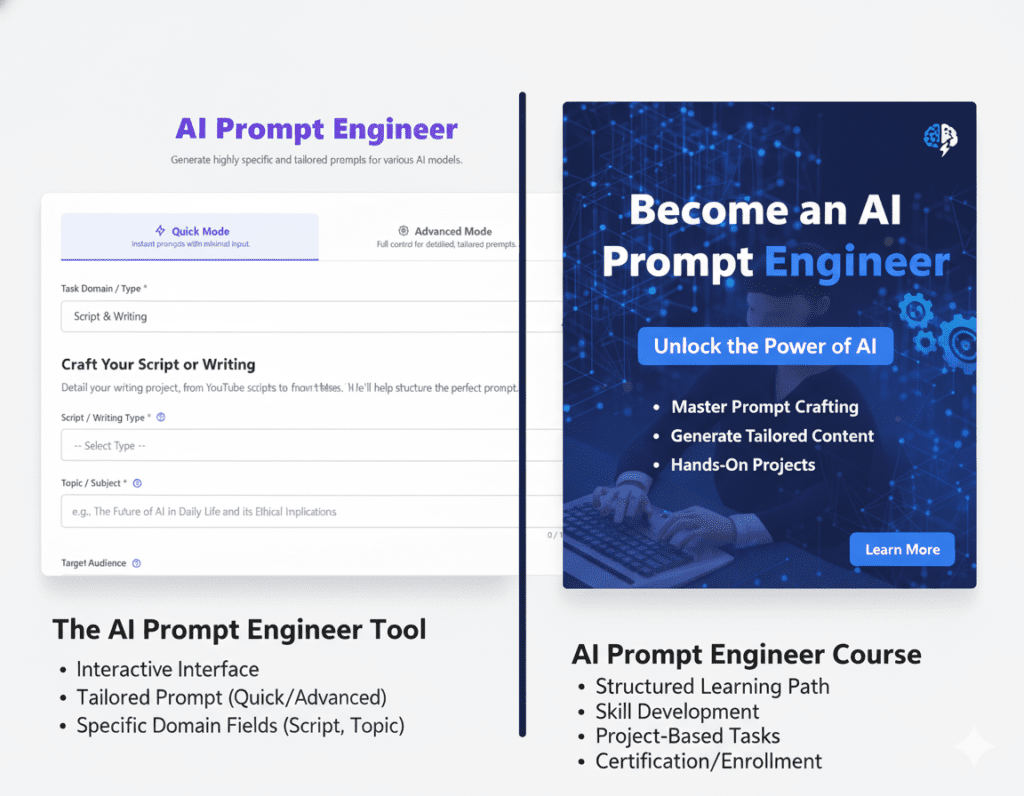
As AI continues to transform content creation, automation, and decision-making, mastering prompt engineering has become a key skill. But how should you get started? Should you enrol in a prompt engineering course, or use a flexible AI prompt engineering tool to get instant results?
Artificial intelligence is transforming the way individuals and businesses create content, solve problems, automate workflows, and make decisions. From writing articles and generating marketing copy to building applications and analysing data, AI tools have become a powerful part of modern productivity.
However, the quality of results produced by AI systems depends heavily on one key factor: the prompt.
A prompt is the instruction you give to an AI system. The clearer and more structured your prompt is, the better the output you receive. This process of designing effective prompts is known as prompt engineering, and it has quickly become one of the most valuable skills in the AI era.
But a common question many users face is:
Should you spend time learning prompt engineering through courses, or should you use an AI prompt engineering tool that generates optimised prompts automatically?
While prompt engineering courses can teach theoretical knowledge and foundational techniques, they often require significant time investment and experimentation before users start seeing consistent results. On the other hand, modern AI prompt engineering tools are designed to eliminate the complexity of prompt creation by generating optimised prompts instantly.
These tools allow beginners and professionals alike to produce high-quality AI outputs quickly, without needing months of training or technical knowledge.
In this article, we will compare both approaches in detail and explain why AI prompt engineering tools are becoming the smarter and more practical solution for most users.
For example:
Basic Prompt
“Write a blog article about AI.”
This prompt is simple but vague. The AI may generate something general without clear direction.
Optimised Prompt
“Generate a 500-word beginner-friendly blog post explaining prompt engineering. Include practical examples, step-by-step explanations, and an engaging tone suitable for new AI users.”
The second prompt provides context, tone, structure, and target audience. As a result, the AI produces a more useful and focused response.
Learning how to structure prompts like this is the essence of prompt engineering. However, mastering this skill manually requires:
-
Continuous experimentation
-
Understanding AI behaviour
-
Testing multiple prompt variations
-
Refining instructions repeatedly
This trial-and-error process can take weeks or even months to master.
This is exactly where AI prompt engineering tools provide a significant advantage: they automate the process of creating optimized prompts instantly.
2. Approach 1: Learning Prompt Engineering Manually
Many people begin their AI journey by enrolling in prompt engineering courses or watching tutorials to learn how prompts work.
These courses typically cover topics such as:
-
Prompt structures
-
Context-based instructions
-
Role-based prompting
-
Chain-of-thought prompting
-
Iterative refinement
While these concepts can be useful, learning them requires dedication and practice before users can confidently apply them in real-world scenarios.
Pros of Learning Prompt Engineering
Deeper Understanding of AI
By learning prompt engineering manually, users gain insight into how AI models interpret instructions and generate outputs.
Greater Customisation
Advanced users can craft highly specialised prompts tailored for specific tasks.
Valuable Long-Term Skill
Prompt engineering knowledge can be applied across different AI platforms and tools.
Cons of Learning Prompt Engineering
Despite these benefits, manual learning comes with several challenges.
Steep Learning Curve
For beginners, understanding prompt structures and techniques can be overwhelming.
Time-Consuming
Users often spend hours experimenting with prompts before finding one that produces good results.
Trial and Error
Even experienced users frequently need to adjust prompts multiple times before achieving the desired output.
Productivity Slowdown
Instead of focusing on creating content or solving problems, users spend large amounts of time refining prompts.
While learning prompt engineering is valuable from an educational perspective, it can slow down productivity for users who simply want efficient AI outputs.
Learning manually can be valuable, but it often slows down productivity and can frustrate users who want faster results.
3. Approach 2: Using AI Prompt Engineering Tools
AI prompt engineering tools are designed to simplify the way people interact with artificial intelligence. Instead of spending time experimenting with different prompt structures, users can rely on intelligent systems that automatically generate optimised prompts for their needs.
These tools are built to make your workflow faster, smarter, and significantly more efficient. Whether you are a beginner exploring AI for the first time or a professional using AI for business tasks, prompt engineering tools eliminate the complexity of writing effective prompts manually.
By combining structured templates, intelligent prompt frameworks, and flexible customisation options, AI prompt engineering tools help users produce high-quality AI outputs with minimal effort.
Key Advantages of AI Prompt Engineering Tools
Time-Saving
One of the biggest advantages of using a prompt engineering tool is the amount of time it saves. Instead of repeatedly testing and refining prompts manually, the tool generates optimised prompts instantly. This allows users to focus more on creating, analysing, and improving their work rather than spending hours on trial-and-error.
Enhanced Flexibility
A powerful AI prompt engineering tool adapts easily to different tasks, industries, and content types. Whether you are writing blog posts, generating marketing copy, creating social media content, developing programming prompts, or brainstorming business ideas, the tool can quickly produce prompts tailored to each scenario.
Consistent High-Quality Results
Manual prompts can often produce inconsistent outputs because small changes in wording can significantly affect AI responses. Prompt engineering tools solve this problem by using optimised templates and structured prompt frameworks. This ensures that every prompt is designed to deliver clear, reliable, and high-quality results.
Beginner-Friendly Experience
Many people are interested in using AI but feel intimidated by the technical aspects of prompt engineering. AI prompt engineering tools remove this barrier by providing an easy and intuitive interface. Even users with no prior experience can generate professional-level prompts and achieve impressive results within seconds.
Scale-able Workflow for Professionals and Businesses
For content creators, marketers, entrepreneurs, and businesses, productivity is essential. AI prompt engineering tools allow users to scale their workflow efficiently by generating prompts for multiple projects at once. This makes it easier to manage large workloads, create content faster, and maintain consistent quality across different tasks.
Improved Productivity and Creativity
When users no longer need to worry about crafting perfect prompts manually, they can spend more time focusing on creativity, strategy, and innovation. The tool handles the technical prompt structure while the user concentrates on ideas and outcomes.
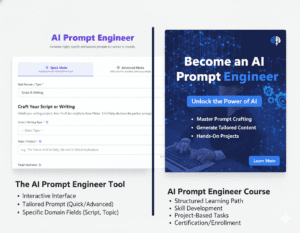
Using an AI tool means you spend less time struggling with prompts and more time creating, analysing, and scaling your work.
4. Side-by-Side Comparison
Below is a clear comparison between learning prompt engineering manually and using an AI prompt engineering tool.
| Feature | Prompt Engineering Course | AI Prompt Engineering Tool |
|---|---|---|
| Learning Curve | High | Very Low |
| Time to Results | Weeks or months | Instant |
| Output Quality | Depends on user skill | Optimized and consistent |
| Flexibility | Manual adjustments needed | Highly adaptable |
| Efficiency | Slow | Extremely fast |
| Ideal Users | Developers and AI enthusiasts | Beginners, marketers, creators |
| Scalability | Limited | Easily scalable |
Winner: AI Prompt Engineering Tool
While courses help users understand prompt concepts, tools provide practical results immediately, making them far more efficient for real-world use.
5. Why AI Prompt Engineering Tools Are the Future
AI technology continues to evolve rapidly. As AI systems become more powerful, users need tools that simplify interactions rather than increase complexity.
This is why AI prompt engineering tools are becoming essential for modern AI workflows.
Instant Mastery
Users no longer need months of learning to generate high-quality prompts. Tools provide optimised prompts immediately.
Improved AI Experience
Instead of worrying about prompt structures, users can focus on creativity, strategy, and innovation.
Major Time Savings
Manual prompt experimentation can consume hours each day. AI tools eliminate this inefficiency.
Cross-Industry Flexibility
From marketing and blogging to programming and business planning, AI prompt tools adapt to multiple tasks effortlessly.
Consistent Results
One of the biggest advantages of AI prompt tools is reliability. Users can generate structured prompts that consistently produce high-quality outputs.
For professionals and businesses that rely heavily on AI, this level of efficiency is invaluable.
6. Tips to Get the Most Out of AI Prompt Tools
Although AI prompt engineering tools simplify the process, there are still ways to maximise their effectiveness.
Start with Templates
Most prompt tools offer pre-built templates for different use cases. These templates provide a strong foundation for generating high-quality prompts.
Customise When Needed
Adjust tone, style, and structure to match your audience or project requirements.
Experiment with Context
Providing additional context often improves AI responses significantly.
Analyse Results
Pay attention to what works best so you can refine future prompts.
Combine Knowledge with Tools
Learning basic prompt concepts can still be useful, but letting tools handle the heavy work dramatically increases productivity.
Conclusion
While learning prompt engineering manually has educational value, AI prompt engineering tools clearly outperform manual learning in speed, flexibility, scalability, and consistency.
If your goal is to save time, enhance AI outputs, and simplify your workflow, an AI tool is the ultimate choice. For beginners and professionals alike, using a smart AI prompt engineering tool is the fastest path to mastery and results.
Prompt engineering is a crucial part of interacting with modern AI systems. However, the method you choose to approach it can greatly affect your productivity and results.
Prompt engineering courses offer valuable theoretical knowledge and can help users understand AI systems more deeply. But they often require significant time, experimentation, and effort before users begin seeing consistent outcomes.
AI prompt engineering tools, on the other hand, provide immediate practical benefits.
They eliminate the complexity of prompt creation, generate optimised prompts instantly, and allow users to focus on creativity and productivity rather than technical experimentation.
For beginners, these tools remove the steep learning curve. For professionals and businesses, they dramatically increase efficiency and scalability.
In today’s fast-moving AI landscape, the ability to generate high-quality prompts quickly is more valuable than spending months learning complex prompt structures.
For this reason, AI prompt engineering tools are rapidly becoming the preferred solution for anyone serious about maximizing the potential of AI.
Call to Action
Start your AI journey today with a flexible and powerful AI prompt engineering tool and experience how much faster, smarter, and more efficient AI-powered workflows can be.
The future of AI productivity isn’t about struggling with prompts – it’s about using the right tools to unlock AI’s full potential.