Introduction
Why Manual Prompt Writing Is Slowing Down Your AI Workflow is becoming an important question in today’s fast-moving AI world. Artificial intelligence has made content creation, automation, coding, marketing, and business workflows faster than ever before.
However, many users still spend countless hours manually writing and testing prompts just to achieve decent AI results. The reality is that manual prompt writing often leads to repeated trial-and-error, inconsistent outputs, and reduced productivity. Small changes in wording can completely change how AI responds, forcing users to constantly refine and rewrite prompts.
This is why more creators, marketers, businesses, and professionals are now turning toward AI prompt engineering tools that simplify the process, generate optimised prompts instantly, and help users save time while achieving faster, smarter, and more reliable AI outputs.
1. The Hidden Problem with Manual Prompt Writing
Many beginners believe AI tools work perfectly with simple instructions. But in reality, AI systems depend heavily on the quality of the prompt.
For example, a vague prompt like:
“Write an article about AI.”
may generate generic and unfocused content.
But a structured prompt such as:
“Write a 1000-word beginner-friendly article explaining how AI prompt engineering tools improve productivity. Include examples, benefits, and actionable tips in a conversational tone.”
produces much better results.
The problem is that creating optimised prompts manually requires constant experimentation.
Users often spend significant time:
- Rewriting prompts
- Adjusting wording
- Testing different tones
- Adding context
- Refining structure
This repeated trial-and-error process becomes exhausting, especially for users who rely on AI daily.
Instead of focusing on creativity and productivity, users spend hours trying to “fix” prompts.
2. Why Manual Prompt Writing Is Slowing Down Productivity
Constant Trial and Error
One of the biggest disadvantages of manual prompting is the amount of testing involved.
A single prompt may need multiple revisions before it generates the desired output. Users often:
- Rewrite prompts repeatedly
- Add missing instructions
- Clarify tone or formatting
- Experiment with different wording
This constant adjustment wastes valuable time.
For content creators, marketers, and businesses managing multiple projects, this inefficiency can become a serious productivity problem.
Inconsistent Results
Manual prompts often produce inconsistent outputs.
Even small wording changes can affect:
- Accuracy
- Tone
- Structure
- Creativity
- Clarity
This inconsistency forces users to spend more time editing and refining AI-generated content.
For professionals who need reliable results quickly, manual prompting becomes frustrating and inefficient.
Difficult for Beginners
Prompt engineering has a learning curve.
Beginners often struggle to understand:
- How much detail to include
- Which instructions improve output quality
- How AI interprets prompts
- Why some prompts work better than others
Without experience, users can easily feel overwhelmed.
Many people abandon advanced AI workflows simply because manual prompt writing feels too technical and time-consuming.
Reduced Workflow Efficiency
The main purpose of AI is to increase efficiency.
But when users spend hours crafting prompts manually, the workflow becomes slower instead of faster.
Tasks that should take minutes can turn into long sessions of prompt experimentation.
This reduces the overall value AI provides.
3. The Rise of AI Prompt Engineering Tools
As AI adoption continues growing, users are looking for faster and smarter ways to interact with AI systems.
This demand has led to the rise of AI prompt engineering tools.
These tools are specifically designed to:
- Generate optimised prompts automatically
- Improve AI response quality
- Save time
- Simplify workflows
- Eliminate manual experimentation
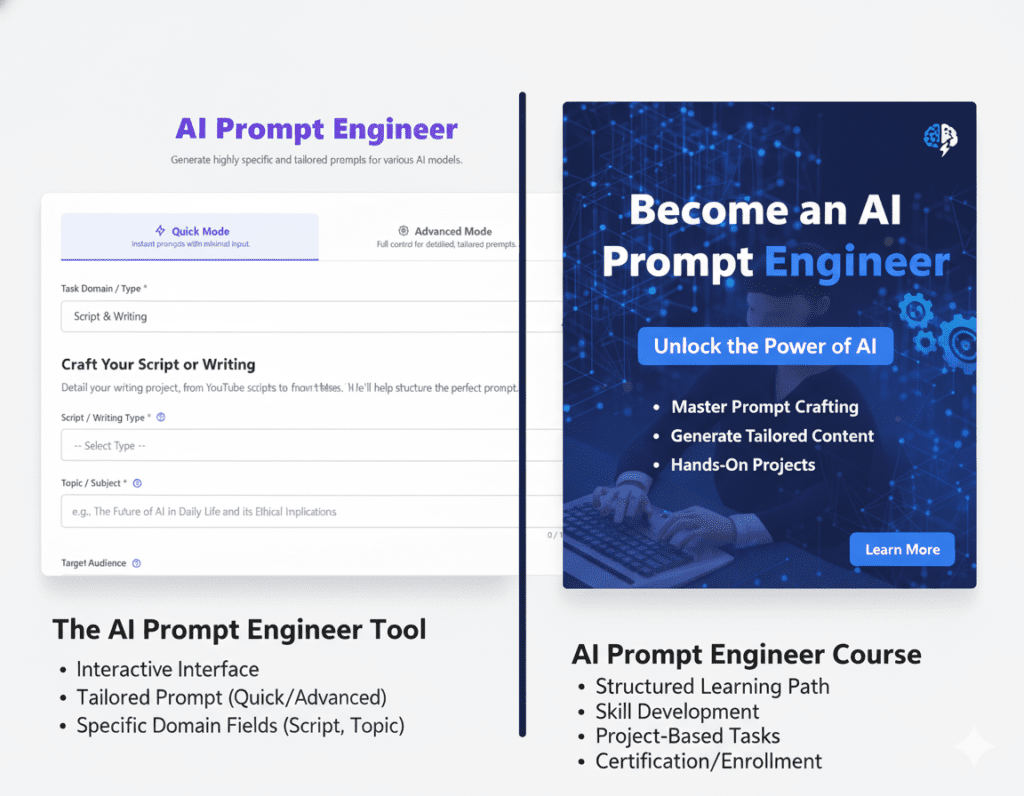
Instead of building prompts from scratch, users simply enter their idea or select a category, and the tool creates a professionally structured prompt instantly.
This dramatically improves productivity and makes AI more accessible to everyone.
4. How AI Prompt Engineering Tools Improve Workflows
Instant Prompt Optimisation
AI prompt tools automatically structure prompts for clarity, context, and effectiveness.
This means users no longer need to spend hours refining instructions manually.
The tool handles:
- Prompt formatting
- Context building
- Tone optimisation
- Output structuring
- Task-specific instructions
As a result, users receive higher-quality AI outputs much faster.
Faster Content Creation
For bloggers, marketers, and creators, speed matters.
AI prompt engineering tools allow users to generate:
- Blog prompts
- Social media prompts
- SEO prompts
- Email marketing prompts
- Ad copy prompts
- Video script prompts
within seconds.
This significantly accelerates content production workflows.
Better Output Quality
One major advantage of optimised prompts is improved output consistency.
AI tools use structured frameworks designed to produce:
- More accurate responses
- Better organisation
- Clearer formatting
- More engaging content
This reduces editing time and improves overall efficiency.
Beginner-Friendly Experience
AI prompt engineering tools remove the technical barrier associated with prompt writing.
Users don’t need advanced AI knowledge to generate professional-level prompts.
This makes AI accessible for:
- Beginners
- Students
- Small business owners
- Freelancers
- Content creators
Instead of learning complex prompting techniques, users can focus directly on results.
Scale-able Productivity
For businesses and professionals handling multiple projects, scalability is essential.
AI prompt tools make it easy to:
- Generate prompts at scale
- Maintain consistent quality
- Handle larger workloads efficiently
This allows teams to increase productivity without increasing manual effort.
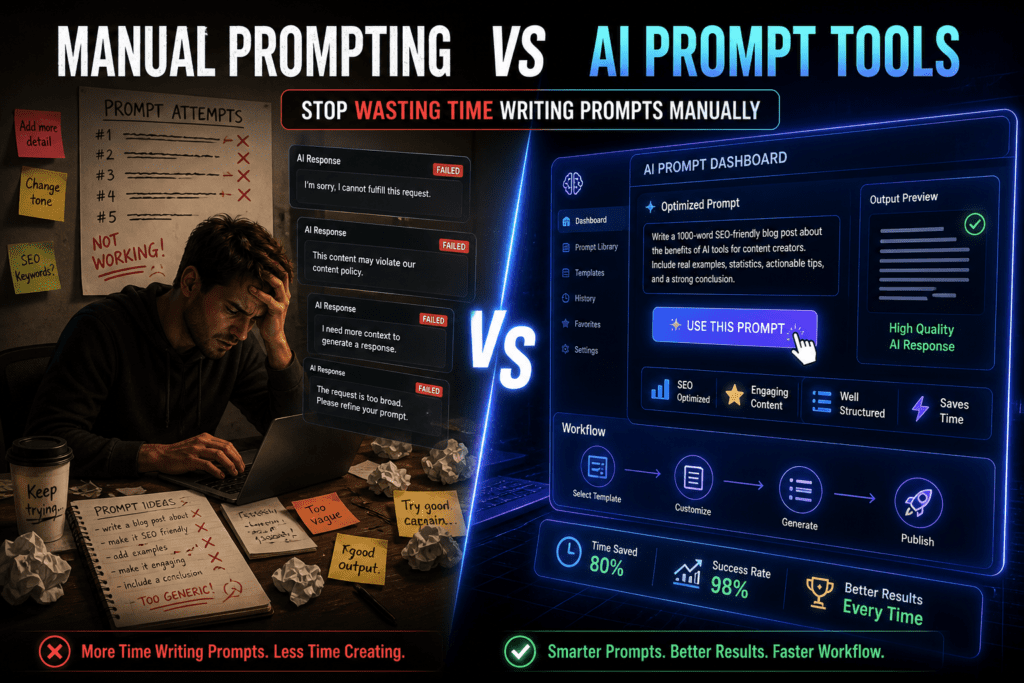
5. Manual Prompting vs AI Prompt Engineering Tools
Here’s a direct comparison between manual prompt writing and using an AI prompt engineering tool.
| Feature | Manual Prompt Writing | AI Prompt Engineering Tool |
|---|---|---|
| Time Required | High | Very Low |
| Learning Curve | Difficult | Beginner-Friendly |
| Workflow Speed | Slow | Fast |
| Output Consistency | Inconsistent | Optimised & Reliable |
| Scalability | Limited | Highly Scale-able |
| Productivity | Reduced by testing | Increased significantly |
| Ease of Use | Technical | Simple & Intuitive |
Clear Winner: AI Prompt Engineering Tools
While manual prompting can work for experienced users, AI prompt engineering tools provide faster, smarter, and more reliable results for most people.
6. Why Businesses Are Moving Toward AI Prompt Tools
Modern businesses value:
- Speed
- Efficiency
- Automation
- Scalability
Manual prompting simply cannot compete with the productivity gains offered by AI prompt engineering tools.
Businesses now use these tools for:
- Content marketing
- SEO optimisation
- Customer support automation
- Social media management
- Copy-writing
- Workflow automation
By reducing manual effort, companies can focus more on growth and creativity.
7. The Future of AI Workflows
The future of AI is not about spending hours learning complex prompt structures.
The future is about:
- Automation
- Simplicity
- Efficiency
- Smart workflows
AI prompt engineering tools represent the next evolution of AI interaction.
As these tools continue improving, users will rely less on manual prompt experimentation and more on intelligent systems that generate optimised prompts automatically.
This shift will make AI faster, more accessible, and far more productive for everyone.
8. Tips to Maximise AI Prompt Tool Performance
To get the best results from an AI prompt engineering tool:
Use Clear Goals
Describe exactly what you want the AI to achieve.
Customise Output Settings
Adjust tone, length, style, or formatting to match your audience.
Experiment with Templates
Explore different prompt categories to improve creativity and efficiency.
Analyse Results
Track which prompts generate the best outputs and refine your workflow over time.
Combine Creativity with Automation
Let the tool handle structure while you focus on ideas and strategy.
Conclusion
Why Manual Prompt Writing Is Slowing Down Your AI Workflow is no longer just a discussion — it’s a reality many AI users experience every day. While manual prompting can help users understand how AI systems work, it often creates unnecessary delays through repeated testing, inconsistent outputs, and time-consuming experimentation.
AI prompt engineering tools solve these problems by generating optimized prompts instantly, improving output quality, and making workflows faster, smarter, and more scalable. For beginners, these tools remove the steep learning curve of prompt engineering, while for professionals and businesses, they provide the efficiency and consistency needed to scale AI-powered tasks effectively.
Instead of wasting hours refining prompts manually, users can focus on creativity, productivity, and growth by leveraging intelligent AI prompt engineering tools designed for modern workflows.
Call to Action
Ready to stop wasting time on manual prompts?
Start using our advanced AI prompt engineering tool today and experience faster workflows, better AI outputs, and smarter productivity with just a few clicks.