The AI Prompts Mystery Nobody Talks About
Imagine this.
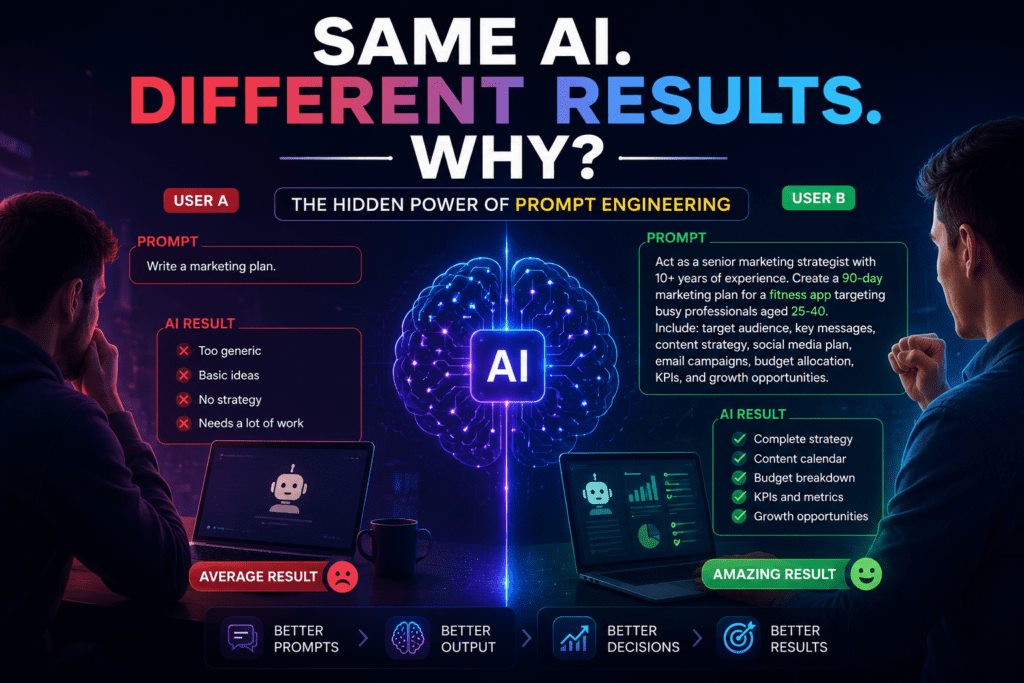
Two marketers sit in the same office.
Both open ChatGPT. 
Both have access to the exact same AI model.
Both want help creating a marketing campaign for a new fitness app.
The first marketer types: “Create a marketing campaign for my fitness app.”
The AI responds with a generic answer: Use social media, Run ads, Create content, Engage customers,
Nothing special.
Meanwhile, the second marketer types:
“Act as a senior digital marketing strategist with 15 years of experience in the fitness industry. Create a 90-day marketing campaign for a fitness app targeting busy professionals aged 25-40. Include customer personas, content strategy, social media plan, email campaigns, budget allocation, KPIs, and growth opportunities.”
The AI produces a detailed strategy worth hundreds of dollars in consulting fees.
Same technology. Same company. Completely different result. Why? The answer reveals one of the most important truths about artificial intelligence today:
The quality of AI output depends heavily on the quality of the input.
This is where prompt engineering enters the picture. And it may become one of the most valuable digital skills of the next decade.
The Biggest AI Myth
Many people believe AI works like magic.
They think artificial intelligence automatically understands exactly what they want.
But AI doesn’t read minds. It reads instructions. When users receive poor responses, they often blame the AI. In reality, the problem is frequently the prompt. Think about it like hiring an employee.
Imagine telling a designer:
“Make me a logo.”
The designer would immediately ask questions.
- What industry?
- What style?
- What colours?
- Who is the target audience?
Without context, even the most talented designer cannot deliver the perfect result.
AI works similarly.
The more information you provide, the better the outcome.
AI Is More Like a Highly Skilled Intern Than a Mind Reader
One useful way to understand AI is to think of it as a highly skilled intern. The intern is intelligent. The intern learns quickly. The intern can perform many tasks. But the intern needs clear instructions. If you give vague directions, you’ll receive vague work. If you provide detailed guidance, you’ll receive much better results.
For example:
Weak AI Prompt
Write a blog post about fitness.
Strong AI Prompt
Write a 1,500-word blog post about fitness for beginners aged 30-45 who want to lose weight. Use a friendly tone, include practical tips, scientific evidence, and a motivating conclusion.
The second AI prompt provides:
- audience
- goal
- tone
- structure
- expectations
As a result, AI performs significantly better.
The Hidden Power of Context
Context is one of the most overlooked aspects of AI interaction.
AI systems don’t know:
- who you are
- what your business does
- who your customers are
- what your goals are
Unless you tell them.
Consider these two prompts.
Prompt A
Create a Facebook ad.
Prompt B
Create a Facebook ad promoting a premium online course that teaches freelance graphic designers how to attract high-paying clients. Target audience is designers with 1-3 years of experience. Use a professional but inspiring tone and focus on career growth.
The second AI prompt gives AI a clear understanding of the situation.
That’s why the output improves dramatically.
Why Experts Get Better AI Results
Have you ever noticed that some people consistently get incredible AI outputs while others struggle?
The difference usually isn’t the AI.
The difference is the user.
Experts naturally provide better instructions because they understand:
- objectives
- audience
- context
- constraints
- desired outcomes
They think strategically.
Beginners often submit short requests.
Experts create detailed frameworks.
This difference can transform average AI responses into exceptional ones.
The Rise of AI Prompt Engineering
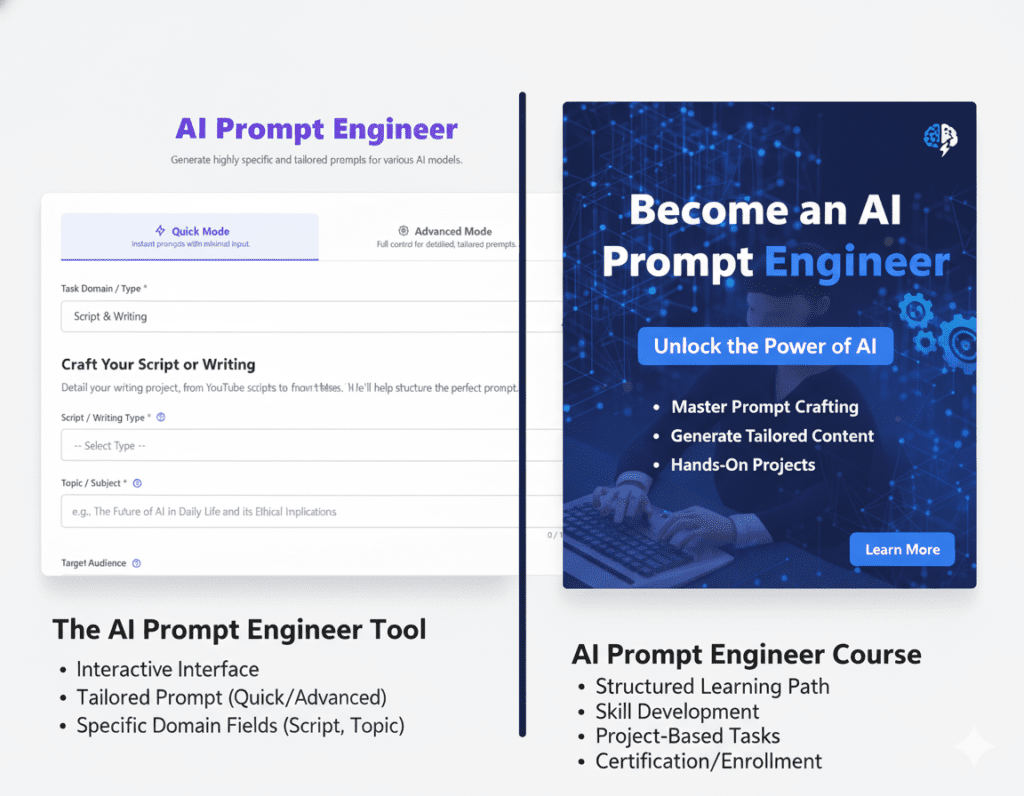
Prompt engineering is the practice of designing instructions that help AI systems generate better results.
It involves understanding how AI interprets language and learning how to communicate effectively with these systems.
AI Prompt engineering is not programming.
It’s communication.
The goal is simple:
Help AI understand exactly what you want.
As AI becomes more common in business, prompt engineering is rapidly emerging as a valuable professional skill.
A Real-World Marketing Example
Let’s compare two marketers.
Marketer A
Prompt:
Give me Instagram content ideas.
Output:
- Share customer testimonials
- Post behind-the-scenes content
- Create educational posts
Generic.
Nothing unique.
Marketer B
Prompt:
Act as a social media strategist specialising in SaaS companies. Create 30 Instagram content ideas for a startup that sells AI prompt engineering tools. Target audience includes marketers, content creators, and small business owners. Include educational, entertaining, and promotional content.
Output:
- detailed content calendar
- carousel ideas
- hooks
- captions
- engagement strategies
The difference is enormous.
The Four Levels of Prompt Quality
Most prompts fall into four categories.
Level 1: Basic Prompt
Example:
Write a blog post.
Very little information.
Results are usually generic.
Level 2: Context Prompt
Example:
Write a blog post about AI marketing.
Better.
But still limited.
Level 3: Structured Prompt
Example:
Write a 1,500-word blog post about AI marketing for small business owners. Use a conversational tone and include practical examples.
Results improve significantly.
Level 4: Expert Prompt
Example:
Act as an experienced digital marketing consultant. Write a 1,500-word article explaining how small businesses can use AI marketing tools to improve customer acquisition. Include examples, statistics, common mistakes, actionable strategies, and a conclusion.
This level often produces professional-quality output.
Why Businesses Are Beginning to Care
Businesses are discovering that AI success depends less on the tool and more on how employees use it.
A company can spend thousands of dollars on AI subscriptions.
Yet if employees write poor AI prompts, productivity gains remain limited.
The opposite is also true.
Employees who understand prompt engineering often achieve impressive results using the same tools everyone else has access to.
This creates a competitive advantage.
The Productivity Multiplier Effect
One well-written AI prompt can save hours of work.
Consider a content creator.
Without AI prompt engineering:
- brainstorm ideas manually
- create outlines manually
- edit heavily
Time required:
3–4 hours.
With prompt engineering:
- generate ideas instantly
- create detailed outlines
- receive higher-quality drafts
Time required:
30–60 minutes.
The productivity difference becomes enormous over weeks and months.
Why AI Sometimes Produces Terrible Results
People often claim:
AI isn’t very good.
But many times the real issue is communication.
Imagine asking a travel consultant:
Plan a vacation.
The request is too broad.
Where?
Budget?
Duration?
Interests?
AI faces the same challenge.
When prompts lack detail, results become unpredictable.
The Future Belongs to Better Communicators
Historically, technology rewards people who learn how to use tools effectively.
The internet rewarded people who learned search engines.
Spreadsheets rewarded people who learned Excel.
Social media rewarded people who learned digital communication.
AI may reward people who learn prompt engineering.
The ability to communicate effectively with AI could become a fundamental workplace skill.
Common AI Prompt Engineering Mistakes
Mistake 1: Being Too Vague
Bad:
Help me market my business.
Better:
Create a 30-day marketing plan for a local bakery targeting young professionals.
Mistake 2: No Audience Information
AI performs better when it knows:
- who you’re targeting
- what they need
- what challenges they face
Mistake 3: No Desired Format
Specify:
- article
- checklist
- table
- report
- strategy document
The format dramatically affects output quality.
Mistake 4: Ignoring Role Assignment
One of the most powerful AI prompt techniques is assigning a role.
Example:
Act as a senior SEO consultant.
or
Act as a professional copywriter.
This provides valuable context.
The Secret Formula Behind Great AI Prompts
Many successful prompt engineers follow a simple structure:
Role
Who should the AI act as?
Task
What should it do?
Context
What background information is important?
Audience
Who is the output for?
Format
How should the response be structured?
Goal
What outcome are you trying to achieve?
This framework consistently produces better results.
Why AI Prompt Engineering Tools Are Growing
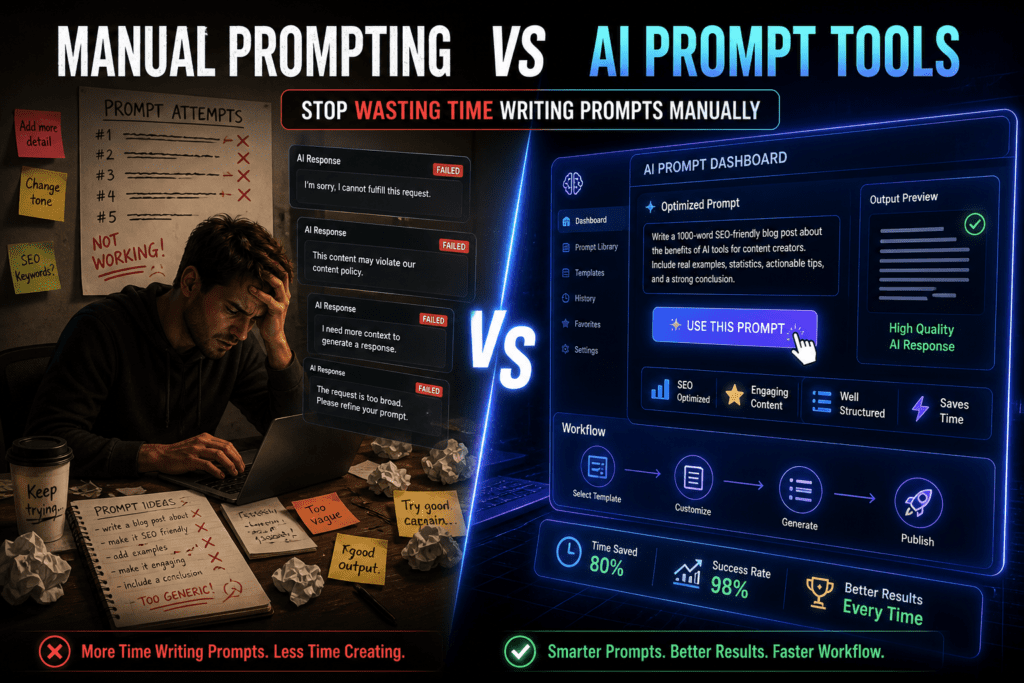
As AI adoption increases, users are discovering that creating effective prompts can be challenging.
This has created demand for prompt engineering platforms that help users generate optimised prompts automatically.
Instead of spending time learning advanced prompt techniques, users can leverage tools that structure prompts using proven frameworks.
This reduces trial and error while improving output quality.
AI Isn’t Replacing Human Thinking
One common misconception is that AI prompt engineering means letting AI think for you.
The opposite is true.
AI Prompt engineering rewards critical thinking.
Users must still:
- define goals
- provide context
- evaluate outputs
- make decisions
AI is a powerful assistant.
But humans remain responsible for strategy and judgement.
The Competitive Advantage Nobody Expected
A few years ago, knowing how to use AI wasn’t considered important.
Today, it’s becoming increasingly valuable.
Tomorrow, prompt engineering may be viewed similarly to:
- digital literacy
- internet literacy
- spreadsheet skills
Organisations that master AI communication will likely outperform those that don’t.
Final Thoughts
Two people can use the same AI tool and receive completely different results.
The reason isn’t luck.
The reason isn’t the AI.
The reason is communication.
Artificial intelligence is only as effective as the instructions it receives.
Those who learn how to communicate clearly with AI systems will unlock better insights, stronger productivity, higher-quality content, and more valuable outcomes.
As AI continues to reshape industries, prompt engineering is rapidly becoming one of the most important skills of the modern digital era.
The future may not belong to those who simply have access to AI.
It may belong to those who know how to talk to it.