Introduction: The AI Marketing Obsession
Open LinkedIn, YouTube, or any marketing blog today and you’ll notice the same trend.
Every week there’s a new AI tool promising to revolutionise marketing.
One tool claims it can write better content.
Another promises unlimited social media posts.
A third says it can automate your entire marketing department.
Businesses are rushing to sign up.
Marketers are testing dozens of platforms.
Founders are spending hundreds or even thousands of dollars on subscriptions.
Yet something strange is happening.
Despite having access to more AI tools than ever before, many businesses are seeing little improvement in their marketing results.
Their traffic isn’t growing significantly.
Their engagement remains low.
Their conversion rates barely change.
Their content looks similar to everyone else’s.
This raises an important question:
If AI is so powerful, why aren’t more businesses seeing extraordinary marketing results?
The answer may surprise you.
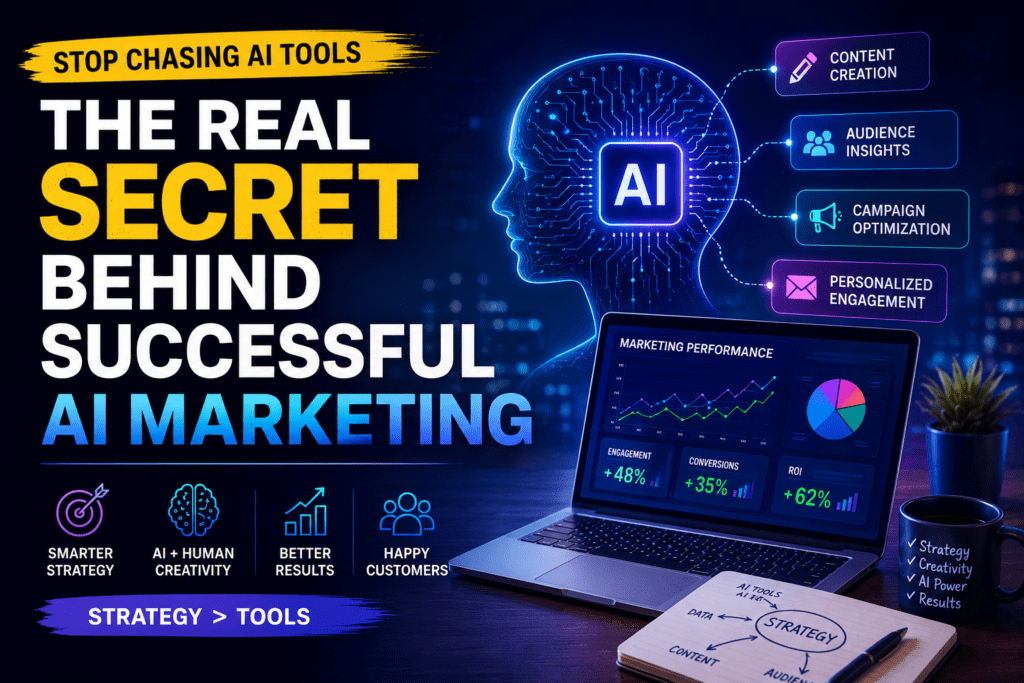
The problem isn’t the tools.
The problem is how people use them.
The Great AI Marketing Misunderstanding
Many businesses believe AI is a shortcut.
They assume that simply purchasing the latest AI platform will automatically improve their marketing.
But marketing has never worked that way.
Imagine buying the world’s most advanced camera.
Will it automatically make you a professional photographer?
Of course not.
The camera is only a tool.
The results still depend on:
- creativity
- strategy
- understanding your audience
- knowing what story to tell
AI is no different.
The most successful marketers don’t win because they have better tools.
They win because they ask better questions and provide better instructions.
Why Most AI-Generated Content Looks the Same
Let’s perform a simple experiment.
Ask an AI tool:
Write a blog post about digital marketing.
Now ask another AI platform the same thing.
The outputs may differ slightly, but they’ll likely contain:
- similar advice
- similar structure
- similar examples
- similar conclusions
Why?
Because generic instructions create generic outputs.
This is one of the biggest reasons businesses struggle with AI marketing.
They’re asking ordinary questions and expecting extraordinary answers.
The reality is that AI can only work with the information it receives.
When marketers provide little context, AI has little to work with.
The Difference Between Average and Exceptional AI Marketing
Consider two business owners.
Both own online fitness coaching companies.
Both use the same AI platform.
Both want to create a marketing campaign.
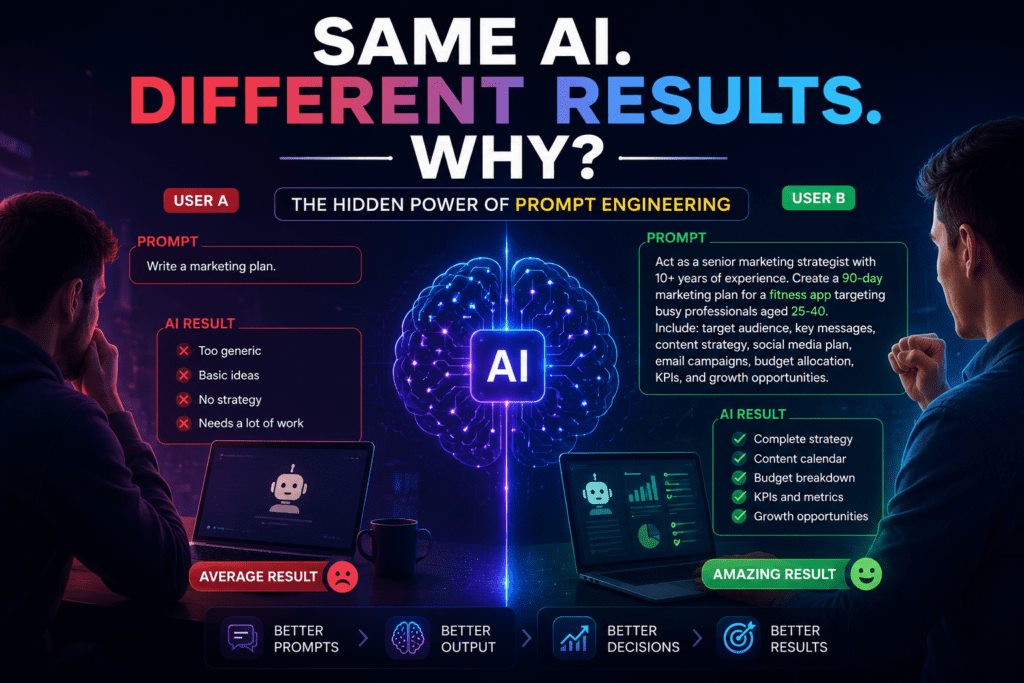
Business Owner A
Prompt:
Create a marketing campaign for my fitness business.
Business Owner B
Prompt:
Act as a senior fitness marketing consultant.
Create a 90-day marketing campaign for an online fitness coaching business targeting busy professionals aged 30–45 who struggle with weight loss due to demanding work schedules.
Include:
- content strategy
- email campaigns
- social media ideas
- lead generation tactics
- conversion strategies
- customer pain points
Who do you think gets the better result?
The second business owner.
Not because they have better AI.
Because they provided better information.
AI Doesn’t Replace Strategy
This is perhaps the most important lesson in modern marketing.
AI can help execute strategy.
It cannot replace strategy.
Many companies start with the wrong question:
What can AI do for us?
A better question is:
What are we trying to achieve?
Successful marketing begins with objectives.
Examples include:
- increasing website traffic
- generating leads
- improving brand awareness
- increasing sales
- building customer loyalty
Once the objective is clear, AI becomes significantly more useful.
Without objectives, AI simply produces random content.
The Hidden Problem Nobody Talks About
Most businesses are not suffering from a lack of AI tools.
They are suffering from a lack of customer understanding.
Think about it.
How many companies can clearly answer:
- Who is our ideal customer?
- What keeps them awake at night?
- What problems are they trying to solve?
- What objections prevent them from buying?
- What motivates them to take action?
Without these answers, even the most advanced AI cannot create effective marketing.
AI doesn’t magically understand your audience.
You must teach it.
Why Customer Research Matters More Than AI
Imagine asking AI:
Write an ad for my software.
The result might be acceptable.
Now imagine saying:
Write an ad for project management software designed for remote teams that struggle with missed deadlines, poor communication, and project delays.
Notice the difference.
The second prompt includes:
- customer problems
- context
- business purpose
As a result, the output becomes more relevant and persuasive.
Great marketing has always been about understanding people.
AI doesn’t change that principle.
The Rise of Prompt Engineering
One of the fastest-growing skills in marketing today is prompt engineering.
Prompt engineering is the process of creating structured instructions that help AI generate better results.
Many marketers underestimate its importance.
They spend weeks researching AI tools but only seconds writing prompts.
That’s like buying a sports car and filling it with low-quality fuel.
The tool matters.
But how you use it matters even more.
A Real Marketing Test
Imagine three marketers trying to generate Instagram content.
Prompt 1
Give me Instagram ideas.
Result:
Generic suggestions.
Prompt 2
Give me Instagram ideas for a marketing agency.
Result:
Better.
But still broad.
Prompt 3
Create 30 Instagram content ideas for a digital marketing agency that helps local businesses increase leads through Facebook advertising. Include educational, entertaining, and promotional content categories.
Result:
Specific.
Useful.
Actionable.
Professional.
The difference isn’t the AI.
The difference is the prompt.
Why AI Works Best as a Marketing Assistant
Many people fear AI will replace marketers.
A more realistic future is that AI becomes an assistant.
Think of AI as a highly intelligent team member.
It can:
- brainstorm ideas
- generate drafts
- analyse information
- summarise research
- suggest improvements
But it still needs direction.
The best results occur when humans and AI collaborate.
Humans provide:
- strategy
- creativity
- judgement
- experience
AI provides:
- speed
- automation
- efficiency
Together they become far more effective than either alone.
AI Marketing by the Numbers
The rapid adoption of AI in marketing is not happening by accident. Businesses are investing heavily in artificial intelligence because it offers measurable advantages in efficiency and decision-making.
Recent industry research shows that marketers are increasingly using AI for content creation, customer support, personalization, market research, and campaign optimization. Organizations that successfully integrate AI into their workflows often report improvements in productivity, faster content production, and better customer engagement.
However, there is an important lesson hidden within these trends. Companies seeing the best results are not simply using more AI tools. They are using AI strategically and combining it with human expertise.
This highlights an important reality: AI alone is not a competitive advantage. The advantage comes from knowing how to use it effectively.
The Productivity Advantage
One area where AI truly shines is productivity.
Consider content creation.
Traditional workflow:
- Research topic
- Create outline
- Draft content
- Edit content
- Publish content
This can take several hours.
AI-assisted workflow:
- Generate research summary
- Create outline
- Draft content
- Edit and improve
- Publish
The time savings can be substantial.
This doesn’t mean AI replaces writers.
It means writers can focus more on quality and less on repetitive tasks.
Case Study: Same AI Tool, Different Results
Consider a hypothetical example involving two e-commerce businesses selling similar products.
Both companies subscribe to the same AI platform.
Both want to create Facebook advertisements.
Company A asks:
Write a Facebook ad for my online store.
The AI generates a generic advertisement that receives average engagement.
Company B asks:
Act as a senior ecommerce marketing strategist. Create three Facebook ads for an online store selling eco-friendly water bottles to environmentally conscious consumers aged 20–40. Focus on sustainability, convenience, and reducing plastic waste.
The resulting ads are significantly more targeted and persuasive.
The difference was not the AI platform.
The difference was the information provided to the AI.
This example demonstrates why prompt quality often has a greater impact on marketing outcomes than the choice of tool itself.
The Biggest Mistakes Businesses Make With AI Marketing
Mistake #1: Publishing Everything AI Creates
AI outputs should be treated as drafts.
Always review, edit, and improve content before publishing.
Mistake #2: Ignoring Brand Voice
Many businesses publish AI content that sounds robotic.
Your content should still reflect your brand personality.
Mistake #3: Using Generic Prompts
The more detailed the instructions, the better the results.
Mistake #4: Forgetting Human Creativity
AI is powerful.
But originality still matters.
Mistake #5: Chasing Every New Tool
Some businesses spend more time testing tools than marketing.
Master a few tools instead of constantly switching.
The Future of AI Marketing
The future isn’t about replacing humans.
It’s about improving human capabilities.
Over the next few years, AI will likely help marketers:
- personalize campaigns
- automate workflows
- analyze customer behavior
- improve targeting
- create content faster
However, businesses that rely entirely on automation may struggle.
The winners will combine:
- technology
- creativity
- strategy
- customer understanding
A Simple Framework for Better AI Marketing
If you want better results from AI, follow this framework.
Step 1: Define the Goal
What outcome do you want?
Examples:
- leads
- traffic
- sales
- engagement
Step 2: Understand the Audience
Identify:
- pain points
- desires
- objections
- motivations
Step 3: Give AI Context
Provide:
- business information
- target audience
- objectives
- desired format
Step 4: Review Outputs
Never publish blindly.
Always edit.
Step 5: Measure Results
Track:
- traffic
- conversions
- engagement
- revenue
Then improve accordingly.
Why Some Businesses Will Dominate the AI Era
History shows that technology rewards those who learn to use it effectively.
The internet rewarded people who understood search engines.
Social media rewarded people who understood digital communication.
AI will reward people who understand how to collaborate with intelligent systems.
The biggest advantage won’t come from having access to AI.
Everyone will have access.
The advantage will come from knowing how to use it strategically.
The Real Secret Nobody Wants to Hear
Many businesses are looking for a magic button.
A tool that automatically generates traffic.
A platform that instantly creates sales.
A shortcut to success.
But marketing has never worked that way.
Success still depends on understanding customers, solving problems, and communicating value.
AI can accelerate those activities.
It cannot replace them.
The businesses that understand this reality are already pulling ahead.
Conclusion
Artificial intelligence is one of the most powerful marketing technologies ever created.
But technology alone doesn’t create success.
The companies achieving remarkable results aren’t necessarily using better AI tools.
They’re using AI more intelligently.
They focus on:
- customer understanding
- strategic thinking
- prompt engineering
- creativity
- continuous improvement
While others chase the latest AI trend, successful businesses focus on fundamentals.
And that’s why they consistently achieve better outcomes.
The future of marketing isn’t human versus AI.
It’s human plus AI.
Those who learn how to combine both effectively will have a significant advantage in the years ahead.